
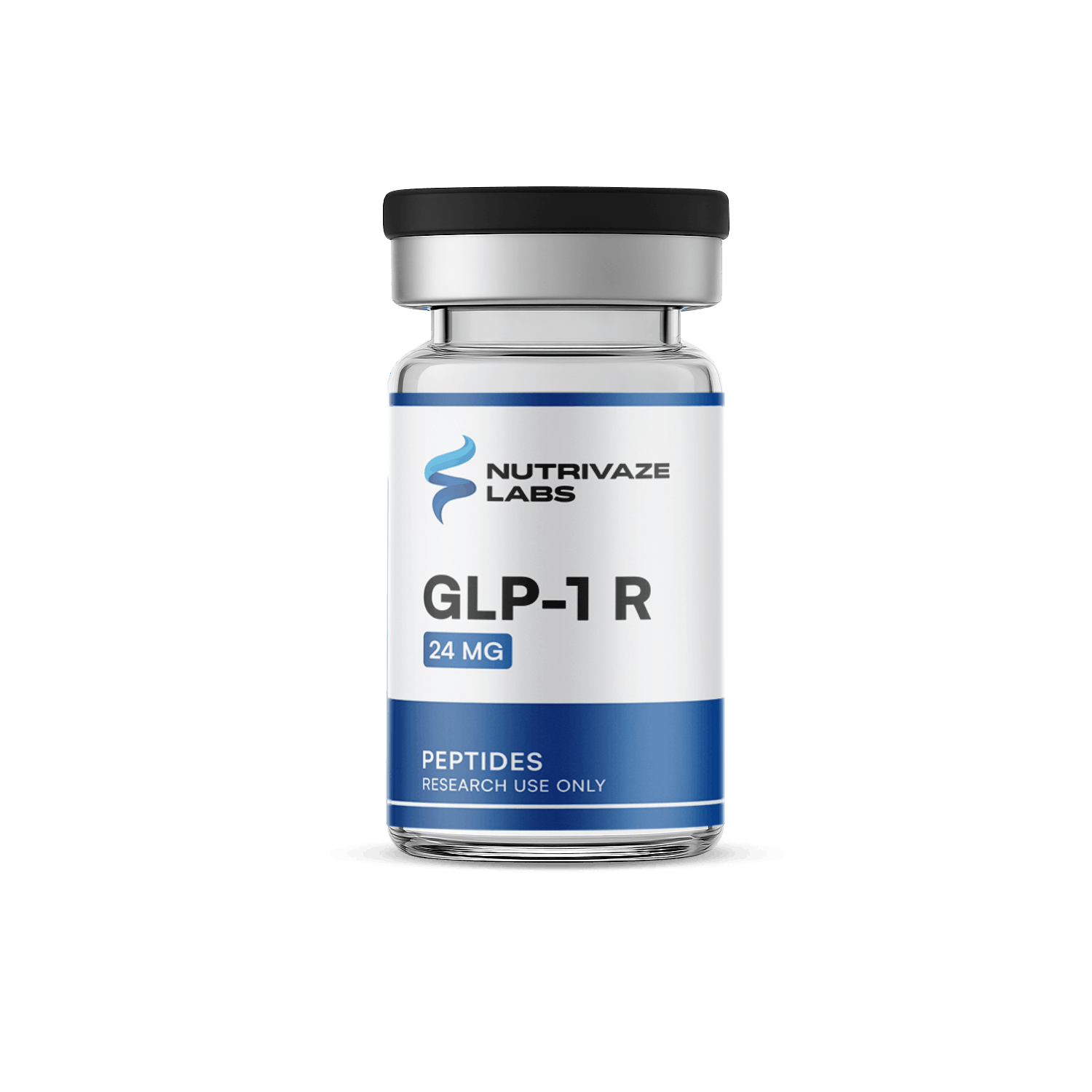
 GLP-1 R — 24 MG
 Original price was: $275.00.$160.00Current price is: $160.00.
$275.00 Original price was: $275.00.$160.00Current price is: $160.00.
Research Use Only
GLP-1 R 24 MG is supplied by Nutrivaze Labs for laboratory research involving GLP-1 receptor-associated pathways and related biological processes.

This product is intended for in vitro and laboratory research use only.
Not for human or veterinary use. Not for consumption, injection, or therapeutic use.
GLP-1 R 24 MG Overview
Glucagon-like peptide-1 (GLP-1) is an endogenous signaling peptide involved in the physiological regulation of glucose-dependent pancreatic signaling, gastrointestinal function, appetite-associated signaling, and energy homeostasis.
The GLP-1 receptor is a G protein-coupled receptor whose activation initiates intracellular signaling pathways that provide an important experimental model for studying the relationship between extracellular peptide signaling and cellular metabolic responses.
Because GLP-1 signaling intersects several physiological systems, the GLP-1 receptor has become an important target for laboratory investigation of metabolic signaling, receptor biology, pancreatic cellular responses, gastrointestinal signaling, and mechanisms associated with energy regulation.
GLP-1 Receptor Signaling
The GLP-1 receptor belongs to the G protein-coupled receptor family and participates in the transmission of extracellular peptide signals into intracellular biochemical responses.
GLP-1 receptor activation is predominantly associated with Gαs-mediated stimulation of adenylyl cyclase and a subsequent increase in intracellular cyclic adenosine monophosphate (cAMP). Increased cAMP can activate downstream effectors including protein kinase A (PKA) and exchange protein directly activated by cAMP (Epac).
These signaling pathways interact with cellular ion-channel activity, intracellular calcium dynamics, and secretory processes. Within pancreatic beta-cell research models, this signaling network provides an important mechanism through which investigators can examine the relationship between receptor activation and glucose-dependent cellular responses.
⸻
Glucose-Dependent Signaling Research
One of the major areas of GLP-1 research concerns the relationship between GLP-1 receptor activation and glucose-dependent insulin-secretory signaling.
Experimental research has demonstrated that GLP-1 receptor signaling can potentiate glucose-stimulated insulin secretion from pancreatic beta cells. Rather than functioning independently of the surrounding metabolic environment, GLP-1-associated signaling interacts with glucose-initiated cellular processes.
This relationship has made the GLP-1 system particularly useful for investigating how extracellular signals modify intracellular metabolic responses.
Research in this area may examine cAMP production, PKA and Epac signaling, calcium-dependent processes, ion-channel activity, insulin-granule dynamics, and other mechanisms involved in pancreatic cellular signaling.
⸻
Gastrointestinal Signaling Research
GLP-1 biology also extends beyond pancreatic signaling.
GLP-1 participates in gastrointestinal regulatory pathways and has been extensively investigated in relation to gastric emptying and gastrointestinal transit. These processes influence the rate at which nutrients move through the gastrointestinal system and therefore form part of the broader physiological relationship between nutrient intake and postprandial metabolic signaling.
The gastrointestinal effects associated with GLP-1 provide researchers with another experimental framework for examining communication among peptide signaling, gastrointestinal physiology, nutrient processing, and metabolic regulation.
⸻
Appetite and Energy-Regulation Research
GLP-1 signaling is also associated with neural and peripheral pathways involved in appetite, satiety, food intake, and energy homeostasis.
Research has examined communication among intestinal GLP-1 signaling, vagal pathways, brainstem structures, hypothalamic systems, and other neural circuits associated with the regulation of feeding behavior.
These relationships demonstrate the broader systems-level significance of GLP-1 biology. Rather than representing an isolated signaling pathway, GLP-1 participates in communication among gastrointestinal, pancreatic, peripheral, and central regulatory systems.
This makes GLP-1 receptor signaling an important research model for investigating how multiple biological systems coordinate responses to nutrient availability and changing metabolic conditions.
⸻
Research Significance
The scientific significance of the GLP-1 system arises from its involvement across several interconnected biological processes.
At the cellular level, GLP-1 receptor activation provides a model for studying GPCR signaling and intracellular second-messenger pathways.
At the pancreatic level, GLP-1 signaling provides a model for investigating glucose-dependent cellular responses and endocrine signaling.
At the gastrointestinal level, GLP-1 research provides insight into mechanisms associated with gastric motility and nutrient transit.
At the systems level, GLP-1-associated pathways provide an experimental framework for investigating communication among peripheral metabolic signals, gastrointestinal processes, and central mechanisms associated with appetite and energy homeostasis.
Collectively, these relationships make GLP-1 receptor biology an important area of contemporary metabolic and peptide research.
⸻
Potential Research Applications
GLP-1 R may be incorporated into appropriately designed laboratory investigations examining GLP-1 receptor-associated mechanisms and related biochemical processes.
Potential areas of research include:
Specific experimental conditions, concentrations, controls, analytical techniques, research models, and interpretation of findings remain the responsibility of the qualified researcher.
Product Specifications
Product: GLP-1 R
Strength: 24 MG
Category: Peptides
Designation: Research Use Only
CAS Number: 53-84-9
Molecular Weight: 663.43 Da
SKU: YPB.105
Storage & Handling
Store at 20°–25°C (68°–78°F).
Protect from light.
Refrigerate after first reconstitution.
Researchers should maintain appropriate laboratory handling and storage procedures and preserve the material under controlled conditions consistent with the supplied product labeling.
Quality & Certificate of Analysis
Nutrivaze Labs is committed to providing research materials accompanied by clear product identification and batch-specific documentation.
A Certificate of Analysis (COA) is available for product batches, allowing researchers to review the analytical documentation associated with the supplied material.
Expiration date and lot number information are provided on the applicable product labeling.
Research Use Only
FOR RESEARCH USE ONLY.
GLP-1 R 24 MG is intended exclusively for laboratory research and scientific investigation.
Not for resale.
Not for human consumption.
Not for veterinary use.
This product is not intended to diagnose, treat, cure, or prevent any disease or medical condition.
Purchase and use of this material are limited to legitimate research purposes. Researchers are responsible for ensuring that acquisition, possession, storage, handling, and use comply with applicable laws, regulations, institutional requirements, and laboratory safety procedures.
GLP-1 R — 24 MG